
Dead Battery Assistance in Austin: What to Do When Your Car Won't Start
Car won't start in Austin, TX? Learn how to identify a dead battery, avoid unsafe jump starts, recognize other starting problems, and get 24/7 roadside assistance.
By Kwik Roadside TeamPublished 16 min read
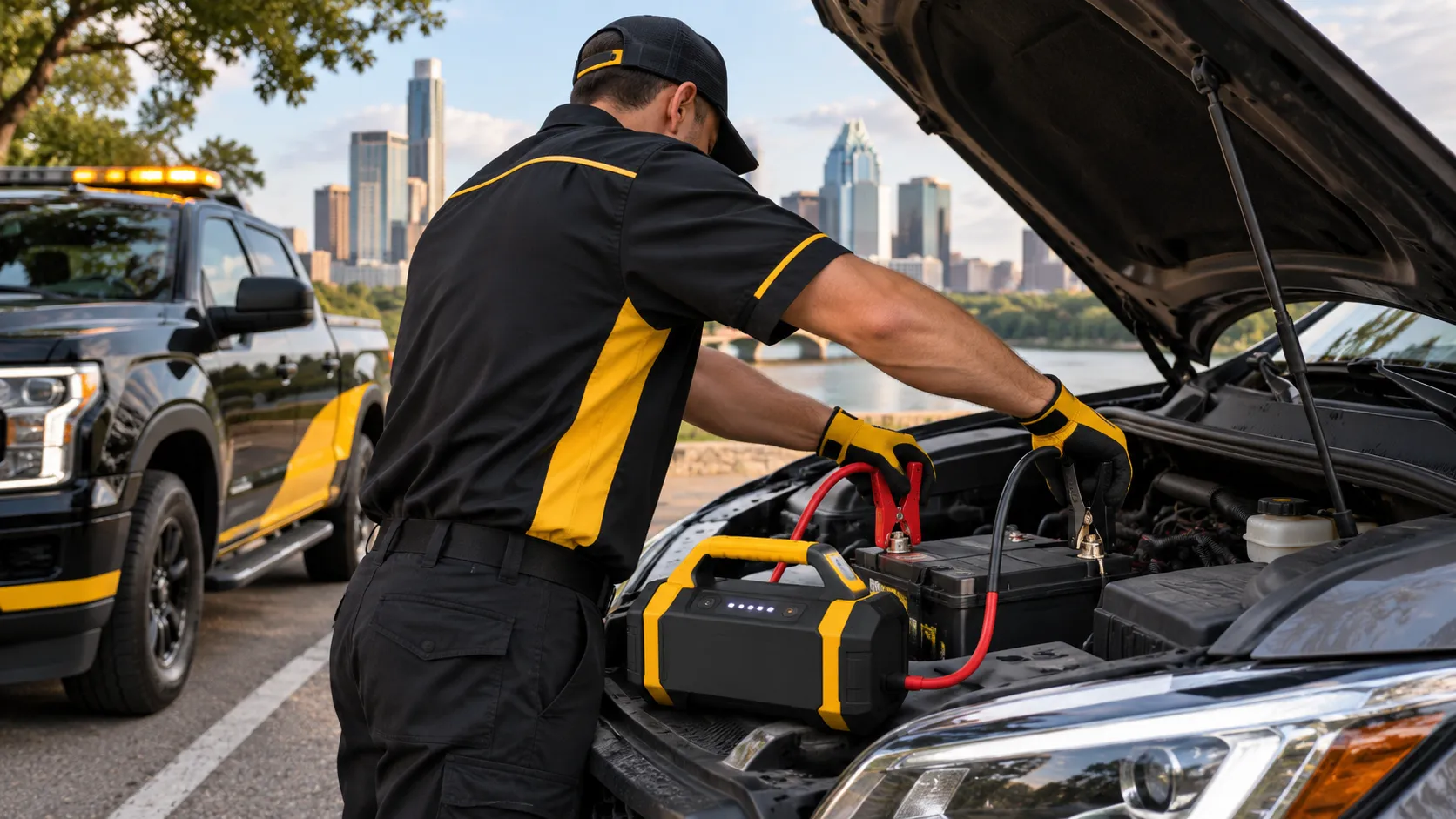
You turn the key or press the start button, but your car refuses to start. Maybe you hear rapid clicking, the dashboard lights flicker, or absolutely nothing happens.
It could happen in your driveway before work, in a parking garage in Downtown Austin, or after shopping at The Domain.
A dead battery is one possible explanation, but not every car that won't start has a battery problem. A faulty starter, charging-system failure, fuel issue, or electronic malfunction can produce similar symptoms.
Knowing the difference can save you time, prevent unnecessary repairs, and help you choose the right roadside service.
In this guide, we'll explain how to recognize a dead battery, which checks you can safely make yourself, when a jump start is appropriate, and what to do if your car still won't start.
Need dead battery assistance in Austin right now?
Kwik Roadside Assistance Austin offers 24/7 mobile jump-start assistance for cars, trucks, SUVs, and motorcycles. Our published flat rate is $75, including the jump start and basic battery-terminal and charging-system checks.
Call or text (512) 855-3255 to request roadside assistance and receive an estimated arrival time.
1. Your Car Won't Start: What Should You Check First?
Before assuming your battery is dead, pay attention to what happens when you try to start the engine.
Different sounds and dashboard behavior can tell you a great deal about the possible problem.
The engine cranks slowly
If you hear the engine turning over more slowly than usual, the battery may not have enough power to operate the starter at its normal speed.
This is a common symptom of a weak or discharged battery.
However, poor battery connections or a failing starter can also produce slow cranking.
You hear rapid clicking
A series of rapid clicks when you turn the key often indicates that the starting system is receiving insufficient electrical power.
The battery may be discharged, deteriorated, or unable to deliver enough current.
Loose or corroded connections can produce similar symptoms.
A professional jump start may resolve the immediate problem if low battery charge is the cause.
You hear one solid click, but the engine doesn't turn
A single click can indicate a problem with the starter motor, starter solenoid, battery, or electrical connections.
If your dashboard lights remain bright, a starter-related issue becomes more plausible, although the sound alone isn't enough for a reliable diagnosis.
A jump start will not repair a defective starter motor.
Nothing happens when you press the start button
If the dashboard stays dark, the vehicle may have lost electrical power.
But if the dashboard lights work normally, check whether the vehicle is properly in Park or Neutral, whether the brake or clutch pedal is being recognized, and whether the key fob is detected.
Some vehicles have manufacturer-specific procedures for starting when a key-fob battery is weak. Check your owner's manual before attempting anything unfamiliar.
The engine cranks normally but won't start
If the engine turns over at its usual speed but never starts running, the problem may involve fuel delivery, ignition, sensors, or another engine-management component.
A jump start is less likely to resolve this type of problem unless insufficient battery voltage is also affecting the system.
For a broader explanation of starting problems, see AAA's guide to reasons a car won't start.
2. What to Do Immediately When Your Car Battery Dies in Austin
The right next step depends on where your vehicle is located.
A dead battery in your driveway is inconvenient. A vehicle that loses power near highway traffic can create a serious safety problem.
If your car won't start at home
If the vehicle is safely parked in your driveway or garage, there is generally no need to rush into attempting a jump start.
Turn off unnecessary accessories, including the radio, interior lights, and climate control.
Make sure the transmission is in Park and the parking brake is engaged.
Then check your dashboard and listen for the symptoms described above.
If you have a compatible portable jump starter and know the manufacturer's approved procedure, you may be able to restore power yourself.
Otherwise, a mobile roadside technician can come to your location.
If your battery dies in a shopping-center parking lot
This can happen after leaving headlights or interior lights on, or when an aging battery finally loses enough capacity that it can no longer start the engine.
If you're parked somewhere like H-E-B, Costco, or The Domain, remain in a safe area and share your exact parking location with the roadside provider.
Give the store name, nearest entrance, parking level, or another useful landmark.
Avoid repeatedly trying to start the engine. If the battery is already weak, repeated attempts may discharge it further.
If your vehicle becomes disabled on I-35, MoPac, or US-183
If your engine stops while you're driving, the problem may be more serious than a discharged battery.
Keep control of the vehicle, activate your hazard lights if they work, and move to a safe location if possible.
Remember that a stalled engine may reduce power-steering assistance or affect the effort required to brake.
If you're stopped beside fast-moving traffic, don't open the hood or attempt to connect jumper cables in an exposed location.
Remain in the safest available position and contact appropriate assistance.
If the vehicle is obstructing traffic, there's an immediate danger, or someone is injured, call 911.
An unsafe roadside location is not an appropriate place to experiment with a jump start.
3. How to Tell Whether It's the Battery, Starter, or Alternator
Three different components are commonly involved when a car won't start: the battery, starter, and alternator.
Understanding their roles can help you avoid paying for the wrong service.
A weak or discharged battery
The battery supplies the electrical power needed to operate the starter and various vehicle systems before the engine is running.
Common signs of battery trouble include:
- Slow engine cranking.
- Rapid clicking when attempting to start.
- Dim or flickering dashboard lights.
- Weak electrical accessories.
- A vehicle that starts after receiving a jump.
However, even a successful jump start does not prove that the battery needs replacement.
It could have been discharged by a forgotten light, or another electrical fault may have caused the problem.
A failing starter motor
The starter is responsible for turning the engine when you initiate the starting process.
If it fails, the battery may have adequate power, but the engine will not crank.
A click without normal engine rotation can be one possible symptom.
A technician may need to test the battery and starting circuit to confirm the actual cause.
An alternator or charging-system problem
In most conventional gasoline and diesel vehicles, the alternator supplies electrical power and recharges the battery while the engine runs.
If the alternator fails, the battery can become discharged because it is no longer receiving the charge it needs.
Warning signs may include a battery-shaped dashboard light while driving, unusual electrical behavior, or an engine that stalls after running for a while.
One particularly important warning: If your vehicle starts with a jump but loses power again while driving, don't assume another jump start is the solution. The charging system needs professional inspection.
Kwik includes basic terminal and alternator checks with its advertised jump-start service, but these do not replace comprehensive electrical diagnostics by an automotive repair shop.
4. When Is It Safe to Jump-Start a Dead Car Battery?
A jump start can be an effective way to restore enough electrical power to start a vehicle.
However, it involves connecting an external power source to the vehicle's electrical system. Incorrect connections or unsuitable equipment can cause damage or injury.
Before attempting a jump start, consider the condition of the battery, the vehicle, and your surroundings.
Situations where a jump start may be appropriate
A jump start may be suitable when the vehicle is safely parked, the battery appears undamaged, and the vehicle manufacturer permits the procedure.
You'll also need compatible equipment and access to the correct connection points.
When you should NOT attempt a jump start
Do not attempt to jump-start a battery that is:
- Visibly swollen, cracked, or leaking.
- Producing smoke or showing signs of overheating.
- Emitting a strong, unusual sulfur or rotten-egg odor.
- Damaged after a collision.
- In a condition where the manufacturer prohibits jump-starting.
Avoid using electrical equipment near leaking battery fluid or potentially flammable gases.
You should also avoid working in unsafe traffic conditions or in locations where the equipment cannot be positioned securely.
AAA explains important safety precautions in its guide to jump-starting a car battery.
What about hybrid and electric vehicles?
Hybrid and electric vehicles can have specialized low-voltage electrical systems and manufacturer-specific starting procedures.
Some use designated connection points that differ from those in conventional cars.
Others place restrictions on how external power can be connected.
Never assume that the procedure for a traditional gasoline-powered car applies to every hybrid or EV.
Consult the owner's manual and use the appropriate equipment.
If you're unfamiliar with the process, contact a technician who can confirm compatibility with your vehicle.
Should you jump-start your own car?
If you have suitable equipment, understand the manufacturer's instructions, and are parked in a safe location, doing it yourself may be reasonable.
But if you're unsure about polarity, voltage compatibility, battery condition, or the correct connection points, professional assistance is the safer choice.
You do not need to take unnecessary risks to save the cost of a roadside call.
5. How Does Professional Dead Battery Assistance Work?
Professional mobile jump-start assistance brings the required equipment to your vehicle, eliminating the need to find another driver with jumper cables.
For someone stranded in Austin, this is particularly convenient in apartment parking garages, office parking lots, residential driveways, and shopping centers.
Step 1: Contact roadside assistance
Call or text (512) 855-3255.
Tell the dispatcher your exact location and what happens when you try to start the vehicle.
For example:
"My car is parked near The Domain in North Austin. The dashboard lights come on, but I hear rapid clicking and the engine won't start."
This description is more useful than simply saying, "My battery is dead."
Step 2: Provide your vehicle information
Share the make, model, year, and type of vehicle.
Kwik advertises jump-start assistance for cars, trucks, SUVs, and motorcycles. Heavy commercial trucks are outside its stated service scope.
If you're driving a hybrid, electric vehicle, or one with a specialized electrical system, mention that immediately.
Step 3: Confirm pricing and arrival time
Kwik currently advertises a flat $75 jump-start rate, including nights, weekends, and holidays.
The service page states that the company aims to arrive in approximately 30 minutes, although traffic, distance, and technician availability can affect the actual arrival time.
Dispatch provides an estimate before sending assistance.
Step 4: A technician assesses the vehicle
Kwik uses commercial jump packs that supply power without requiring a second vehicle.
The technician can inspect basic battery connections, use compatible equipment to attempt the jump start, and check whether the engine continues running.
The company's published service also includes basic battery-terminal and alternator checks.
Step 5: Understand the result
If the engine starts, the technician can explain why further battery testing may be necessary.
If the vehicle cannot be started, the problem may require an automotive repair shop or a tow.
Kwik indicates that it can help arrange towing when a breakdown cannot be resolved on-site.
A professional jump start is a starting-assistance service, not a guarantee that every non-starting vehicle can be repaired roadside.
See Kwik's 24/7 jump-start service in Austin.
6. What if Your Car Still Won't Start After a Jump?
This is where identifying the actual problem becomes important.
A failed jump start does not automatically mean you need to buy a new battery.
Several possibilities should be considered.
The battery is too damaged to function
An old or internally damaged battery may no longer hold enough charge or deliver sufficient starting power.
Repeated jump-start attempts won't restore its original condition.
A battery load test or appropriate diagnostic test can help determine whether replacement is necessary.
The battery connections are faulty
Loose, damaged, or corroded terminals can prevent sufficient electrical current from reaching the starter.
A technician may identify a visible connection problem, but damaged cables or other electrical faults may require repair.
Do not attempt to clean or disconnect a battery that shows damage, overheating, leakage, or other hazardous conditions.
The starter is defective
If the battery has sufficient power but the starter cannot turn the engine, an automotive mechanic may need to inspect the starting circuit and starter motor.
The alternator is not charging
If the vehicle initially starts but the battery repeatedly discharges, the charging system could be malfunctioning.
A proper test can determine whether the alternator, wiring, or another component is responsible.
The issue isn't electrical
Fuel-system, ignition, engine-management, and mechanical failures can also prevent starting.
If the engine cranks normally or there are unusual noises, smoke, warning messages, or signs of mechanical damage, avoid repeated starting attempts.
When the cause is uncertain, a proper diagnosis is more valuable than repeatedly paying for jump starts.
7. What Should You Do After Your Car Starts?
Getting the engine running is only the first step.
One of the most common mistakes is assuming that a successful jump start means the battery is fully charged and ready for normal use.
That isn't necessarily true.
Don't assume the battery has recovered
If the battery is old, severely discharged, or damaged internally, it may not hold enough charge to start the engine again.
A short drive may restore some energy, but it is not a reliable substitute for testing the battery.
Have the battery tested
Once the vehicle is running normally and it is safe to drive, arrange a battery and charging-system test.
An automotive service center or participating auto-parts retailer may be able to assess the battery's condition.
Testing is especially important if the engine had difficulty starting before the current incident or if you've already needed multiple jump starts.
Avoid unnecessary stops before getting help
If the battery is seriously weak, switching the engine off could leave you stranded again.
Depending on the vehicle's condition, it may be sensible to travel directly to an appropriate repair location rather than make several stops.
However, if the battery warning light stays on, electrical systems begin failing, or the engine runs abnormally, don't continue driving simply to recharge the battery. Stop somewhere safe and arrange assistance.
Decide whether the battery needs replacement
A battery that repeatedly fails testing or can no longer provide reliable starting power should be evaluated for replacement.
Kwik's advertised service does not include selling or installing replacement batteries.
The company provides jump-start assistance and basic checks, helping you determine the next step.
For more information, see AAA's guide to warning signs of a failing car battery.
8. Why Austin's Hot Weather Can Be Hard on Car Batteries
Austin drivers often think of winter as the season when batteries fail.
Cold weather can expose a weak battery because the engine may demand more starting power while battery performance is reduced.
But Central Texas summer heat also contributes to battery deterioration.
How high temperatures affect batteries
In conventional lead-acid car batteries, prolonged exposure to high temperatures can accelerate internal chemical degradation, corrosion, and fluid loss.
Over time, this reduces the battery's ability to maintain reliable starting performance.
AAA identifies extreme heat as an important factor that can shorten car battery life.
See AAA's vehicle maintenance advice for extreme heat.
Why a car may fail after sitting in a parking lot
Imagine driving to a store in South Austin on a hot afternoon.
Your car starts normally at home, but after shopping for an hour, it refuses to restart.
The battery may already have been deteriorating before that trip. The heat and the next high-current starting demand may expose its weakness.
This doesn't prove the temperature alone caused the failure; battery age, electrical faults, connections, and charging condition also matter.
What about Austin's occasional cold fronts?
Even when the weather has been warm for weeks, a sudden temperature drop can reveal a battery that is already near the end of its useful life.
This is one reason testing an aging battery before seasonal temperature changes can be worthwhile.
9. Is There Free Dead Battery Assistance on Austin Highways?
Yes. Some drivers may be eligible for assistance through the Highway Emergency Response Operator (HERO) program.
Operated by the Texas Department of Transportation (TxDOT) and its partners, HERO provides free roadside services on designated highway corridors in the Austin area.
The program includes jump-start assistance, help moving disabled vehicles to safety, flat tire changes, and other limited emergency roadside services.
Which highways does HERO cover?
Its designated service routes include portions of I-35, US-183, US-290, Highway 71, and MoPac.
Availability and operating hours vary by route and segment.
Austin HERO phone: (512) 974-4376
For current coverage and operating hours, visit the official TxDOT Austin HERO program page.
When might private roadside assistance be the better option?
HERO does not serve every driveway, shopping center, residential street, or apartment parking garage.
If you're stranded outside its coverage area or operating hours, a private mobile roadside provider may be more suitable.
Kwik advertises 24/7 service in Austin and surrounding locations within its coverage area.
If you are on a dangerous highway shoulder, however, prioritize traffic safety and the appropriate emergency response over choosing a provider based solely on price.
10. Dead Battery Assistance at Home, Work, or Around Austin
A mobile jump start is useful because a car battery problem doesn't always occur somewhere with convenient access to a second vehicle.
At home or in an apartment complex
A dead battery can leave your vehicle stranded before you even begin your journey.
In many circumstances, a technician can access your car in a driveway or apartment parking area without requiring a tow truck.
If you live in a gated complex, provide entry instructions when booking.
At work or in a parking garage
If the vehicle is in a multi-level garage downtown, share the garage name, parking level, and nearest entrance or pillar number.
Kwik uses portable commercial jump packs, so the technician does not need to park a second vehicle directly beside your car.
Access and safe working conditions still need to be confirmed.
At shopping centers and restaurants
Whether you're near H-E-B, The Domain, South Congress, or another commercial area, share your GPS location and a recognizable landmark.
This can help the technician locate the vehicle more efficiently.
On major Austin roads
If you're stranded on I-35, MoPac, US-183, or Highway 71, describe your direction of travel and nearby exit.
A road name alone often isn't specific enough.
If the car is in an unsafe position, tell dispatch before they arrive. The location may need to be made safe before any battery work can be attempted.
Check Kwik's Austin service areas for coverage information.
11. How to Reduce the Risk of Another Dead Battery
A vehicle battery will eventually wear out, but basic preventive maintenance can reduce avoidable failures.
Check your battery's age and condition
A battery approaching the later stages of its expected service life deserves closer attention, especially in hot climates.
Don't rely on age alone. Battery condition depends on usage, temperature exposure, charging behavior, and other factors.
An appropriate battery test can help determine whether replacement is becoming necessary.
Pay attention to slower starts
If the engine begins cranking more slowly than usual, don't ignore the change.
The symptoms may be early signs of a deteriorating battery, poor electrical connection, or starting-system problem.
Avoid leaving accessories running
Interior lights, headlights, dash cameras, and other electronics can draw power when the engine is off.
Some vehicles automatically turn accessories off, but not every accessory is protected in the same way.
Check that unnecessary equipment is switched off before leaving the vehicle.
Consider how often you drive
Repeated very short trips may not allow enough time to replenish energy consumed during starting.
Vehicles left parked for extended periods can also experience battery discharge from normal electrical loads or aftermarket accessories.
If your vehicle is rarely driven, ask a qualified technician whether an appropriate battery maintainer would be useful.
Have the charging system checked when necessary
If a battery repeatedly becomes discharged, the problem may not be the battery itself.
An alternator, parasitic electrical drain, poor connection, or other issue could be responsible.
Replacing a battery without identifying the underlying fault may lead to another breakdown.
12. Need Dead Battery Assistance in Austin, TX?
When your car won't start, the last thing you need is uncertainty about the problem, the price, or when help will arrive.
A weak battery may only need a professional jump start to get the engine running.
But a starter failure, damaged battery, or charging-system problem may require a different solution.
Kwik Roadside Assistance Austin provides 24/7 mobile jump-start service, with a published flat rate of $75, including nights and weekends.
Our advertised service includes:
- Mobile jump-start assistance for cars, trucks, SUVs, and motorcycles.
- Commercial jump packs that don't require a second vehicle.
- Basic battery-terminal and alternator checks.
- Upfront pricing and an estimated arrival time.
- Assistance at homes, workplaces, parking garages, and suitable roadside locations.
- Help arranging towing when the problem cannot be resolved on-site.
To request help, tell the dispatcher where your vehicle is located, what happens when you try to start it, and your vehicle's make and model.
Call or text: (512) 855-3255
Get 24/7 Dead Battery & Jump Start Assistance in Austin →
If your vehicle is stopped in an immediately dangerous location, anyone is injured, or the vehicle presents a serious traffic hazard, call 911. Do not attempt a jump start beside moving traffic or on a visibly damaged battery.
Frequently asked questions
- Can Kwik help if my car battery dies in Austin, TX?
- Yes. Kwik provides 24/7 mobile jump-start assistance for cars, trucks, SUVs, and motorcycles in Austin and its advertised service areas. Technicians use commercial jump packs and perform basic checks. Call or text (512) 855-3255 to confirm availability and an estimated arrival time.
- How do I know if my car won't start because of a dead battery?
- Common signs include slow engine cranking, rapid clicking, dim dashboard lights, and weak electrical accessories. However, starter, alternator, and connection problems can produce similar symptoms. A battery and electrical-system check is the most reliable way to identify the cause.
- Is it safe to jump-start my car if the battery is dead?
- A jump start may be appropriate if the battery is undamaged, the location is safe, and the vehicle manufacturer permits the procedure. Never attempt to jump-start a battery that is cracked, swollen, leaking, overheating, or showing other dangerous signs. Consult your owner's manual or request professional assistance if you're unsure.
- How much does dead battery assistance cost in Austin?
- Kwik advertises a flat $75 jump-start rate, including nights, weekends, and holidays. The published service includes a mobile jump start and basic battery-terminal and charging-system checks. Confirm the quoted service and availability before dispatch.
- Does Kwik offer 24-hour emergency jump-start assistance?
- Yes. Kwik advertises 24/7 jump-start dispatch throughout its Austin service area. The company aims for approximately 30-minute arrival times, but traffic, distance, and technician availability can affect the actual response time.
- What happens if my car still won't start after a jump?
- The battery may be severely damaged, or the problem may involve the starter, alternator, electrical connections, fuel system, or another component. Kwik performs basic on-site checks and says it can help arrange towing when the vehicle cannot be started. A qualified mechanic may be needed for a full diagnosis.
- Can Kwik jump-start my car in an underground parking garage?
- Usually, provided the vehicle is accessible and the location is safe. Kwik uses portable commercial jump packs, so a second vehicle is not required. Tell dispatch the garage name, parking level, nearest entrance, and any access restrictions.
- Can I drive immediately after my car has been jump-started?
- If the engine runs normally and there are no warning signs of a charging-system problem, you may be able to drive to a repair facility for battery testing. A successful jump start does not guarantee that the battery is fully charged or healthy. If the battery warning light stays on or the car behaves abnormally, stop safely and seek professional help.
- When should I visit a mechanic instead of requesting another jump start?
- Arrange a mechanical or electrical inspection if the engine cranks normally but won't start, the vehicle repeatedly loses battery charge, it stalls after a jump, or there are persistent dashboard warnings, smoke, unusual noises, or other signs of a fault. Repeated jump starts are not a substitute for diagnosing the underlying problem.
- Can I get free battery jump-start assistance on Austin highways?
- Texas DOT's Austin HERO program provides free roadside services, including battery jump starts, on designated highway corridors during specified operating hours. Call 512-974-4376 to request HERO assistance and check the official TxDOT website for coverage and operating hours.
Keep reading

Car Lockout Service Austin: Keys Locked Inside? Your Safe Options
Locked your keys inside your car in Austin, TX? Discover what to do first, mistakes to avoid, how professional car unlocking works, and when to call 24/7 roadside assistance.
· 14 min read
Flat Tire Assistance Austin TX: What to Do, Stay Safe & Get Help
A flat tire can happen anywhere in Austin. Learn how to stay safe, whether you can drive, what to do without a spare, and where to find roadside help.
· 13 min read